
17:35
Dominic Walters asks Trevor Williams: How do you see communicators’ role in helping organisations to mitigate risk?
It’s about messaging, says Trevor. “Understand intimately what is driving the business and have conversations with different parts of the business in the right language. It’s a tough job because you have to think at different levels, communicating to senior leaders, middle managers and others. You need adaptable people who can communicate across levels, but in a way that is coherent."
17:27
Trevor Williams' closing takeaways for our organisations:
- The risk environment has fundamentally changed. Volatility is embedded. Geopolitical dynamics, economic fragmentation and systemic shocks are now structural features of firms’ operating environment.
- The rules-based international order is eroding. Power competition, sanctions and coercive trade measures are reshaping global commerce. Firms must navigate a world where predictability has diminished.
- Trade rules are being rewritten. Supply chains are politicised. Financial systems are tools of statecraft. Even domestic firms feel the impact through pricing, availability and regulatory spillovers.
- But this environment is not only a threat – it can be a source of competitive advantage.
17:01
Trevor Williams, former chief economist at Lloyds Bank Commercial Banking, closes a fantastic day. He talks about three disrupters:
- Workforce – population and demographic change. Ageing is accelerating. People over 65 are growing in most industrialised countries.
- Weather – climate changed
- Technology – all the sum of human knowledge putting into algorithms and making it available to everyone.
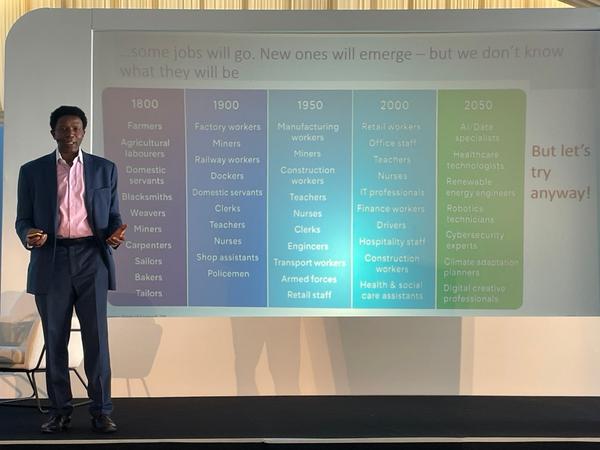
“We can’t say that technology won’t destroy jobs, but new jobs will be created – we just don’t know what they are. We can’t plan for them. The future is unknown. There is no evidence that technological change destroyed jobs in the long run.”
So what jobs will be created in 2050? Robotics technicians? Climate adaptation planners? Healthcare technologist?
16:20
Helen Theofanous from Mott McDonald reflects on the biggest change in an organisation’s history – one that had to be kept secret and delivered fast.
One of the delegates asks, how do you manage emotive situations and ensure news is delivered in an authentic way and not scripted?
“Honesty is always the right way. Even if we don’t feel it’s the right decision, it’s best to say it as it is. Not everyone is going to like this change and we have to be OK with that, and let it settle."
Helen admits they had to accept they couldn’t completely control the narrative from leaders throughout the business. "Our leaders were experiencing the change also. So we had a series of briefings between 48 hours and five days in advance to give them a heads-up, so they could ask questions. Empower leaders. But remember they need time to digest this, and don’t forget there are other communications they are receiving.”
16:09
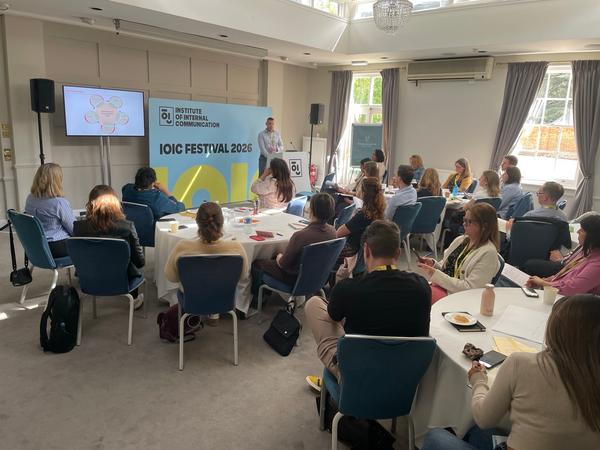
Tim Prince from Network Rail on translating strategy into everyday behaviours on the frontline: “The evidence routinely shows that frontline engagement and alignment is strongest when these five Cs happen: clarity, context, consistency, connection, cadence. When they have a deep understanding of the mission and their connection to it, people at the sharp end of delivering work are able to make decisions.”
And on clarity: “When we looked at the volume of information frontline employees get in team briefing, we cut it back by 90% – thousand of words – and those employees told us they felt they were getting more detail.”
15:58
Sarah Meurer talks about how Elsevier is using data driven insights to create better communication experiences. “AI has made IC more data-driven by turning everyday employee signals into insights, As communicators, we can now analyse patterns across channels and search behaviour to see what employees are actually engaging with, but also ignoring. And then we can segment audiences by interest and style.
It allows for personalisation at scale. We can very quickly tailor messages to persona groups and test content performance. That means we can move from intuition-based writing to evidence-based optimised copy.”
15:12
Frank Dias: “I saw the Copilot champions as a deep comms pipeline, especially for local stories. We are not just seeing them as change campaigns for the sake of it,; we want to work with them to surface stories we could share. We had touchpoints to make them feel loved and cared about, and see what was in it for them.
This is about building long-term capability, Frank adds. “We need o partner with key players who have strategic capabilities, like L&D, who are working on talent development and skills gaps. There is so much training out there that is heavy, and people don’t have time. So our bespoke modules are bitesize – 10-15 minutes. It makes it more digestible.”
15:01
Laura Targett and Frank Dias from Quilter are talking about their AI Copilot journey, from lift-off to long-term impact.
They realised that AI adoption was not necessarily a skills problem. Initial scoping uncovered:
- Hype and fear – people were either over-excited or over-worried about making mistakes or the impact on jobs.
- Uneven understanding. Some people were very confident. Other colleagues hadn’t touched it. One-size-fits-all messages wouldn’t work.
They treated the campaign like a behaviours change programme, not a tech rollout.
Laura Targett: “A key objective was to make it simple, easy and safe – a clear human story. What Copilot is for and not for, with easy prompts. We built in social proof, not polished demos. Momentum built through quick wins, and we had 163 local champions – they shifted norms faster than internal comms ever could.”
Curiosity > wins > stories > habits > impact
14:33
Talking about sustainability and ethics, Lucy Atkinson of AG Impact says internal communicators need to know when to say no and push back. “In many cases, we are pressured to communicate. If we don’t have the evidence to back it up, we are putting ourselves and organisations in danger.
“I'm seeing conversations around sustainability and reframing it as risk management. If it is going to affect the materiality and profit of your business, it is not a sustainability risk, it is a risk that needs to sit front and centre of other risks. So have the right conversations in your business. Make it clear it is not something you can choose to ignore. It is an opportunity to lead that shift in conversation.”
14:18
Rachel Miller: “When you are called in to change, think about what capacity you have – for tier 1, tier 2 and tier 3 projects. It starts the conversations around what the business actually needs. When stakeholders need advice or guidance, showing our working out is really helpful. If you are trying to be strategic, help the stakeholders understand where their change fits in to your work.”
Inform, involve and inspire during change, says Rachel. That means one-way broadcasting; two-way comms, collaboration and dialogue; and immersive experiences (although Rachel acknowledges that inspiring during change is a stretch target – but it is possible).
14:05
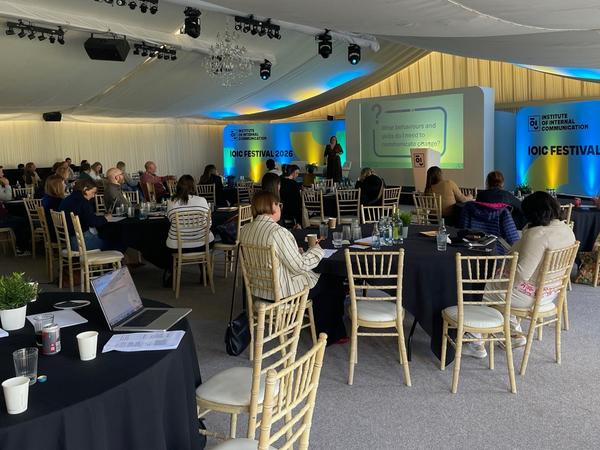
It's the afternoon. We've had lunch. The sun is shining. And we are back in the Inspire zone, where Rachel Miller is talking about change. She asks: what word comes to mind to finish the phrase 'Change is...'. The responses from delegates?
-
Exhausting
-
Stressful
-
Unsettling
-
Emotional
-
Inevitable
"No one ever says it's exciting," says Rachel.
12:48
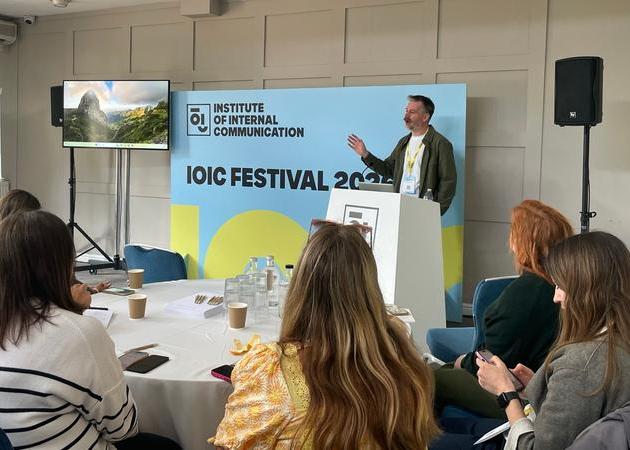
There's been a murder in the James room. Steve Hayes from GreenSquareAccord shares a case study about how GSA tackled complaints through an immersive murder-mystery-style engagement activity.
It was a success! Aside from lasting evidence of operational improvement, a colleague engagement survey highlighted that the activity has played a big part of strengthening organisational narrative and helping people understand their part in where things go wrong.
Steve says: "We have brought complaints down, but we are not perfect. We have a long way to go. It’s important to recognise that."
Final tips:
1. Any conversation about any customer sticks when it is real, not theoretical.
2. Experiment with new ways of engaging, even though it can be hard to find the headspace to do that. If it doesn’t cost a lot of money, just go for it. “With this project, there wasn’t much to lose. The worst thing that could have happened was that it bombed at the pilot.”
3. Make people feel something. Think about your experiences as a customer.
11:55
In a session on leadership, Teresa North from Broom & Room recalls a CEO who restructured a team using customer language. The team became the Peace of mind team, with job titles linked to what customers need. A brave approach, but you can see why it would work.
Teresa's three top tips for championing customer voice:
1. Ask the right questions. What are the problems we need to solve?
2. Fight for the verbatim customer comments. Hear the words your audience uses.
3. Show your working out. And be cautious around using AI. "You need to still get your fingernails dirty." If you outsource the verbatim to AI, you don’t have the working out.
11:33
In a session on culture and people, I am listening to various versions of Bonnie Tyler’s Holding Out For A Hero. Some rocky, some poppy and, naturally, the original.
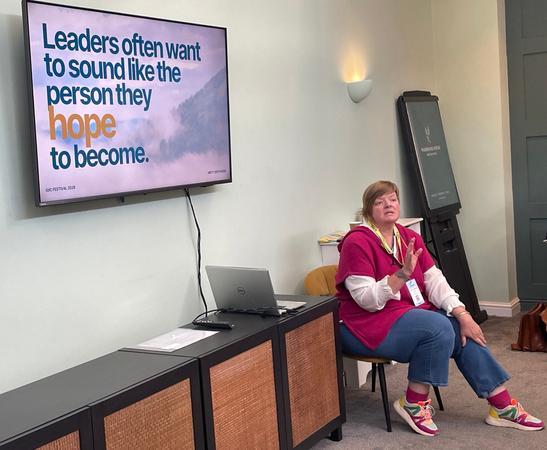
Independent IC and change leader Misty Oosthuizen's point (as if Bonnie Tyler needs a point) is that tone matters when you are sending out a message.
"Do we go for a dramatic version of comms? Do we go for something funky for Gen Z? Do we go for the classic Bonnie version?"
We have to be realistic about what tone we are presenting and how we present ourselves – and how we portray leaders. Can you keep it up?
"As IC pros, we can’t communicate vanity projects. Credibility is important. It doesn’t matter how pretty the comms are if you are not meeting people where they are."
11:02
57% say they are not getting relevant comms (IC Index 2026).
Carmen Trachenko: “Strategy is often lots of buzzwords from the top. But on the ground it can feel like a train wreck.
“It comes down to the layer inbetween senior leaders and managers: can you identify the good ones, train them up and get them to reinforce messages better than leadership and translate them to people?”
Dominic Walters asks, what are the characters of “the good ones”?
“Authenticity,” says Carmen. “A bit of humour, being human and acknowledging it’s hard and they don’t have all the answers. They're going to peppered with questions they don’t have the answer to. They need to be calm and personable in written and in-person comms.”
10:52
Becky Bushell takes some optimism from the IC Index findings – particularly that employees have said they want to hear more good stories.
“Invest time in that. There is an opportunity there. The majority of my time is spent trying to unlock the complex and difficult messages around change, but we should plough more of our time into bringing good stories to life, and how we can be more innovative, especially as people are going home and dealing with the difficult external environment.”
10:43
Carmen Trachenko from PricewaterhouseCoopers LLP says the IC Index finding that most stood out was the decline in trust in leaders.
“When there is a lack of trust, organisations put in layers of bureaucracy that creates barriers to innovation and trying new things. If we show more trust in our employees, and leaders extend that hand, efficiencies can improve. But trust is earned. One email does not trust make. Over time you have to show you are listening.”
10:37
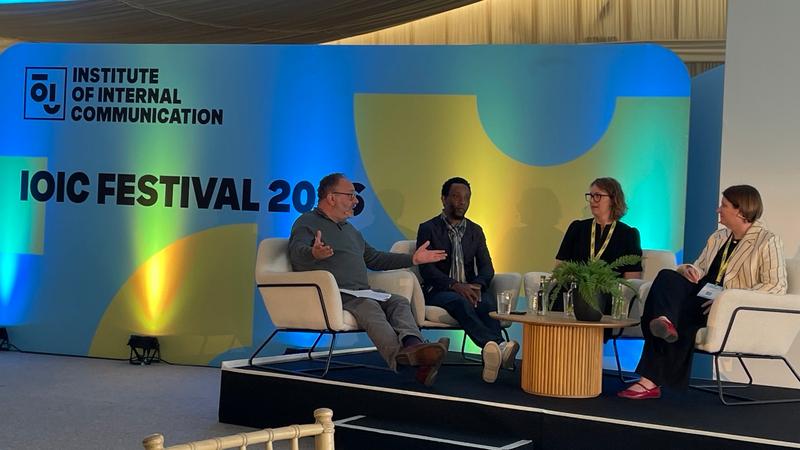
IOIC president Dominic Walters is leading a panel on the latest IC Index findings.
Joe Salmon, from Iron Mountain (and IOIC Board member) says transformation and uncertainty is ongoing for businesses and IC, but for the people impacted, it doesn’t feel like BAU. "In Iron Mountain, we try to tell the complete story, Recognise the wins, connect people to the values and give people the reasons for change – the need to grow. Engagement drops when people don’t understand the reasons for change."
Becky Bushell from Tridos Bank says the current environment has huge implications for organisations like Tridos Bank. "When sustainability’s at your core, and support for society is being scrapped, it puts pressure on organisations that have a mission to promote a healthy planet and healthy people. It’s a deliberate choice to work at our bank. People expect us to be a shining light in a difficult environment. And it’s a constant challenge to balance being profitable, being innovative and having a competitive edge, but also to be the organisation people have chosen to be a part of.”
10:05
Susanna Holten, Ipsos Karian and Box: “We have to be talking with leaders about the things we can control and things we can’t.
“Decipher how people actually receive IC – what time and what channels – and it needs to feel hyper relevant. Have the courage to be bolder.
“For us, the job is about understanding humans and human behaviour. We know what people respond to, what lands, what doesn’t, how they are feeling. That’s our job.”
And a note for your diaries – the full IC Index is out on 20th May...
10:02
Brace yourself. In the 2023 IC Index, employees said they have 15 minutes to read, view or listen to internal comms.
Now? 2026? Most people have TEN minutes or less – and 21% said they have “none – hardly any time” to engage in IC.
09:56
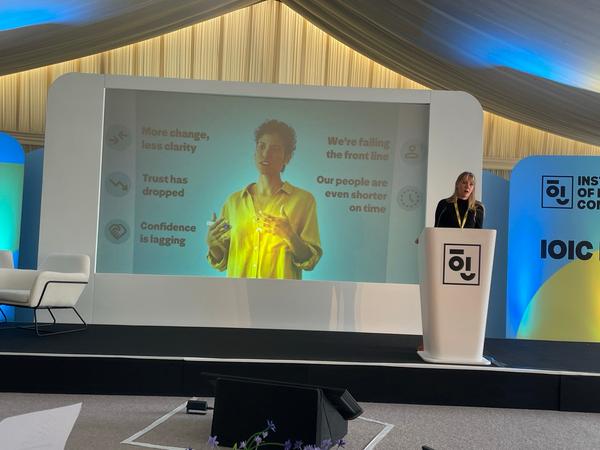
Susanna Holten from Ipsos Karian and Box shares a sneak peak of the IC Index 2026. In her own words, she’s going to ”bring the mood down a bit”.
UK confidence is at its lowest level (only six per cent of the public thinks the economy is going to get better). Shorter CEO tenures than ever before. UK productivity lagging behind other markets. 21% of employers planned redundancies in Q1.
So we need a reality check.
“We’ve been waiting for things to get back to normal so we can get back to doing things the way we’ve always done them, but things need to change. For us as a profession, it’s about challenging influencing and responding to the new reality.”
There’s a 12pt increase in employees saying their organisation has made redundancies in the last year vs 2024, and 58% do not agree their organisation is good at helping employees adapt to change. About half (49%) say their organisations are not clearly communicating why things are changing.
There is a very steep drop off in trust in leadership and CEOs. “It is IC’s job to hold up a mirror. If trust is low, it’s hard for IC to land the right messages as we are fighting that tension. Help leaders address the reality.”
09:39
Jennifer Sproul on why IOIC decided to refresh its brand: “We wanted to be clearer about what we believed and be bolder about saying it. IOIC needed to reflect how internal comms has changed. Our purpose is to champion IC – not quietly, not apologetically and with conviction.
“The context we are working in is tough. Our organisations are under pressure – but so are we. There are no efficiency gains, strategic goals met and no risk understood met or mitigated without internal communication.
“We are the internal intelligence of an organisation. We can advise on what will succeed or stall before it is too late to change course. We need to show our offer more confidently than we have been. Perceptions need to change.”
09:31
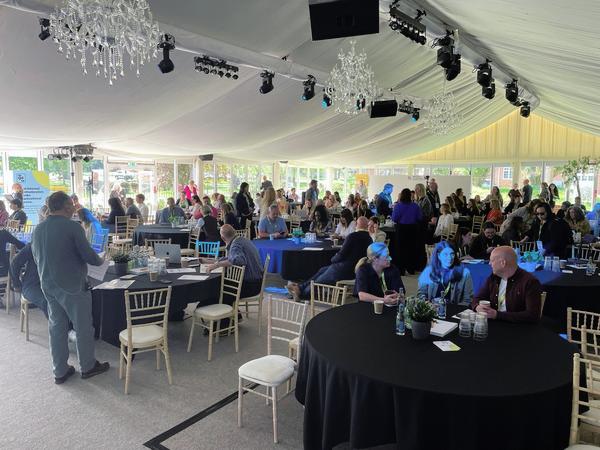
The Inspire Zone is looking pretty full. It's show time. Chief executive Jennifer Sproul is about to take to the stage to welcome everyone.
07:55
Ah, the IOIC Festival. We meet again.
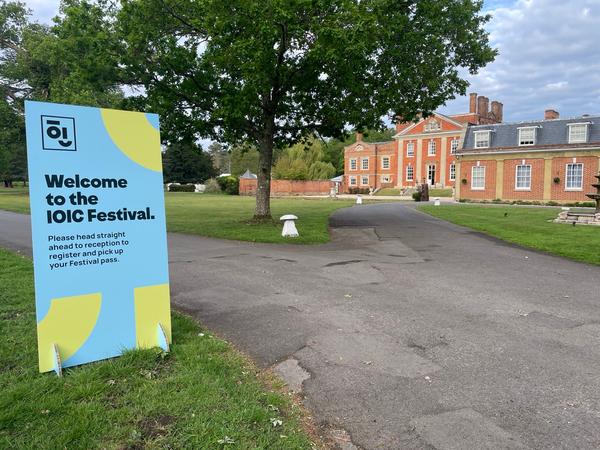
It's now in its sixth year – and I've been to them all (a Festival OG) – and at a new location. We find ourselves in Warbrook House in Eversley, which is stunning. It's basically like a Downton Abbey full of internal comms professionals (we literally have the whole venue to ourselves).
I got here last night and, aside from the great venue and grounds (very green, very peaceful, lots of cows), the most striking thing is how brilliant the IOIC branding looks. The blue and yellow boards are everywhere – crisp, clear, fresh. It looks the part. And now we're getting ready for some unmissable content.
I'll be live-blogging here throughout the day, so stop by every now and again for updates. (I'll be back tomorrow too)